24 June 2026
Open a Company in Belgium
Read here about the rules and procedures for opening a company in Belgium, presented by our team of Belgian lawyers.

Our team can help you open a company in Belgium and comply with the ongoing business requirements applicable in this country.
| Quick Facts | |
|---|---|
| Types of companies | NV – a public limited company BV – a private limited company VOF – general partnership CommV – limited partnership Sole trader |
Minimum capital | No more minimum capital required for the BV/SRL |
Minimum number of shareholders | 1 for the BV/SRL |
| Shareholder liability | Limited to the amount of their capital investment |
| Residency requirements for foreign investors | No |
| Full foreign ownership permitted (Yes/No) | Yes |
| Company name requirements | Original Does not infringe a name that is already registered |
| Registered office requirement | Based in Belgium |
| Main registration documents | Memorandum and Articles of Association |
| Mandatory corporate registration | With the Crossroads Bank for Enterprises Other tax and social security registrations |
| Licenses and permits | Industry-specific |
| Annual filing | Yes |
| Corporate tax rate | 25% |
| Other taxes for companies | 30% withholding tax on dividend payments 21% standard value-added tax and 0%,6%, 12% reduced rates 30.57% or 25% of the gross salary social security contributions, depending on the type of employee Payroll tax, real property tax, stamp duty and other taxes apply |
| Tax incentives | Investment deductions for R&D activities Offset of tax attributes (in some cases) Innovation income deduction regime (subject to conditions) |
| Foreign entities in Belgium | – branches, – subsidiaries, – representative offices |
Timeframe for incorporation | 2 weeks |
Bank account required for share capital (YES/NO) | YES |
| General steps to open a company | – choose legal structure, – submit Articles of Association, – prepare documentation, – choose available name, – register with Crossroads Bank for Enterprises and tax authorities, etc. |
| Residency requirements for directors | Can be Belgian or foreign natural persons. |
| Shelf companies | Are pre-registered legal entities that are incorporated and then made available for purchase. |
| Number of double taxation agreements | around 95 |
| Personal income tax for sole traders | Progressive rates, based on earned income. Our lawyers in Belgium can give you the exact rates. |
| VAT registration | Mandatory for all taxable activities that exceed certain thresholds. |
| VAT rates | – 21% (standard); – 12%, 6%, 0% (reduced) |
| Local secretary required (YES/NO) | NO |
| Virtual office possibility (YES/NO) | YES |
| Remote company formation | Our lawyers can help you with the incorporation process remotely, through a power of attorney. |
| General required documents | – Articles of Association, – identification documents, – proof of registered address, – application form, etc. |
| Assistance | We can help you open a company in Belgium, and assist in tax-related matters through our partner accountants in Belgium. |
What types of companies can I open in Belgium?
The types of Belgian companies are:
- The private limited company (Besloten Vennootschap/Société à Responsabilité Limitée, BV/SRL, which replaced the former BVBA/SPRL under the 2019 Code) does not require a minimum share capital, following a number of changes to its regime. The company can have one or more individual or legal entities as founding members. They can be nationals or foreigners. The shareholders of a Belgian BV will be accountable for the company’s debts and obligations to the extent of their contributions.
- The public limited company (Naamloze Vennootschap/Société Anonyme, NV/SA) requires a minimum share capital of 61,500 euros – in cash or in kind. The founders can be nationals or foreigners, natural persons or legal entities that will contribute to the company’s capital in exchange for shares. The shareholders’ liability is only to the extent of the contributions made to the company’s capital.
- Partnerships that can be general (société en nom collectif/vennootschap onder firma, SNC/VOF), or limited (société en commandite/commanditaire vennootschap, SComm/CommV);
- Cooperative companies (société coopérative/coöperatieve vennootschap, SC/CV), which since the 2019 Code have limited liability and no minimum capital; they replaced the former forms with unlimited liability (société coopérative à responsabilité illimitée/coöperatieve vennootschap met onbeperkte aansprakelijkheid, SCRI/CVOA) and limited liability (société coopérative à responsabilité limitée/coöperatieve vennootschap met beperkte aansprakelijkheid, SCRL/CVBA). Both former forms were abolished.
- Branch offices, subsidiaries, or representative offices: foreign companies are allowed to set up separate enterprises from the parent company, where the foreign company will be a shareholder in a Belgian company. A foreign legal entity can also open an extension in Belgium – this is the branch and it will perform the same business activities and the foreign corporation will be liable for the branch’s debts and obligations in Belgium.
- The sole proprietorship: the simplest business form that can be incorporated in Belgium. There is no distinction between the founder and the company, and the individual is fully liable with his assets.
Our team invites you to watch a short video on company creation in Belgium:

What are the main steps required to open a company in Belgium?
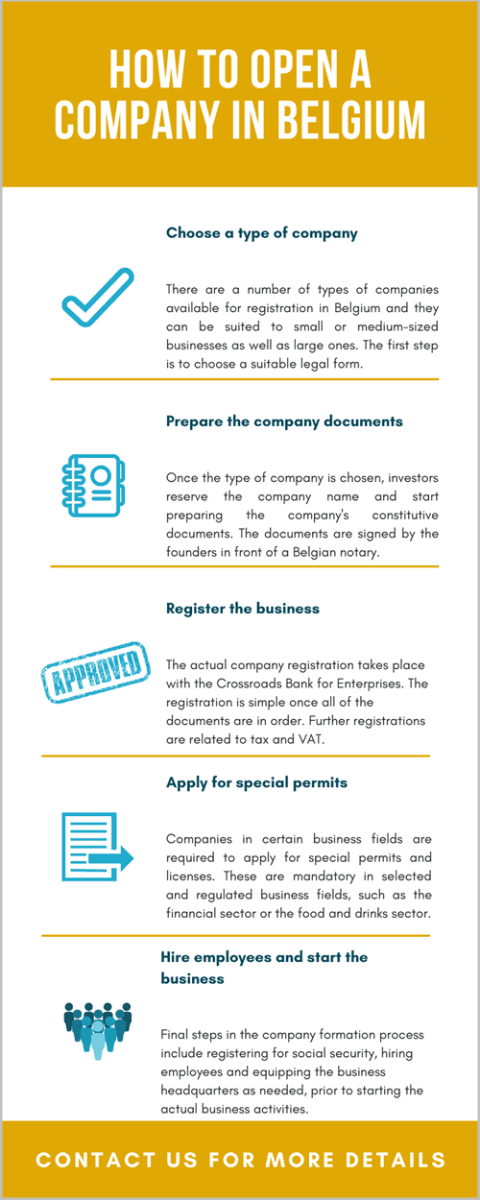
The following incorporation stages are mandatory when opening a corporation in Belgium (an SRL/BV or SA/NV company):
- Draw up the company documents: the Articles of Association are drafted by a notary in Belgium and will include details about the company itself as well as the names of the shareholders and their shares in the company.
- The business plan: a business plan for the future company needs to be drafted and will include the company project (products and services offered, market study, human and financial resources and requirements) as well as a financial plan; these are all unified into a provisional plan and submitted to the notary.
- The bank account: the new Belgian company will have a bank account opened in its name that will serve the business purposes and will also be used to deposit the share capital.
- The registration of the incorporation documents: the Articles of Association are legalized by a notary once they are final and then they are published in the Belgian Official Journal.
- The registration of the company: the new legal entity is registered with the Crossroads Bank for Enterprises.
- The VAT number: once registered, the new legal entity can ask for a VAT number; small enterprises with an annual turnover up to EUR 25,000 can use the VAT exemption (franchise) scheme.
- Social security registration: this is needed for companies in order to hire employees and registration with a payroll agency will also be required.
- Special permits: some companies may find that special permits and licenses are required for their type of activity; one of our attorneys in Belgium can offer more details on how to set up a company in Belgium and obtain the suitable license or permit.
How will my company be taxed?
Corporate taxation in Belgium applies for all companies on their worldwide profits and income, including capital gains, at a standard rate of 25% (20% on the first EUR 100,000 for qualifying SMEs).
Other taxes for companies in Belgium include payroll taxes, transfer taxes, the value-added tax, a real estate tax, stamp duty, and social security contributions. A company is considered a tax resident in Belgium if it has its main establishment, registered office, or management office in the country.
What accounting rules must the company observe?
The Belgian GAAP is used when preparing the company’s annual accounts. Large companies are subject to more complex requirements for submitting their annual financial statements.
Can anyone open a company in Belgium?
Yes. There are no nationality restrictions and foreign nationals are permitted to fully own the company they open in this country.
Non-European investors may be required to obtain a professional card if they are interested in starting a business and remaining in the country for long-term purposes.
This can apply when:
- They are not nationals of an EU member state, nor of Liechtenstein, Iceland, Switzerland, or Norway;
- They will work as a self-employed professional in Belgium (the card is issued by the competent region);
- They will set up a business as a natural person. Other situations can also apply.
Who can act as a company director in Belgium?
There are no mandatory requirements in terms of the company director’s nationality or residence status.
There is no formal requirement for foreign company directors to stay in Belgium; however, the following two scenarios can apply in the case of EU member state citizens:
- They stay in the country for less than three months: they may need to declare their presence to the municipality;
- They stay for more than three months: they submit a different application to the municipality that applies in their case, and they will remain in the country as a self-employed person or an employee.
Company directors who are not EU-member state citizens will:
- Stay in the country for less than three months, based on a visa C;
- Stay for more than three months based on a visa D.
Are there special rules for company management and control in Belgium?
Public limited companies are subject to more complex management requirements, given their particulars. This means that:
- Either a sole director, a board of at least three directors (two if there are only two shareholders), or a two-tier structure can be chosen;
- In the one-tier system, the company is run by the board of directors (or a sole director);
- In the two-tier system, a supervisory board oversees a management board.
Does it matter where I base my business in Belgium?
Because the country is composed of three regions, there are differences in the way local authorities handle economic activity regulations.
Where you choose to establish your company can be influenced by the particularities that apply to the Brussels-Capital Region, Flanders, or Wallonia.
If you want to set up a company in Belgium and want details about foreign investments, you can contact our law firm in Belgium.
In case you need immigration services in another country, you should know that we have a wide network of immigration law firms in Greece, Switzerland, Poland, Sweden and even in Australia or New Zealand.